

What Is Progressive Die
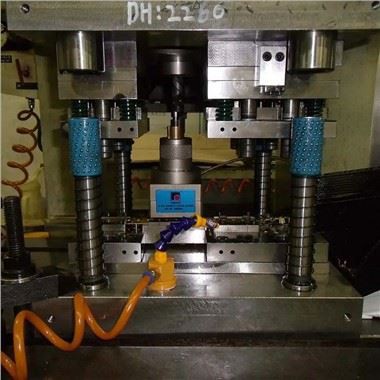
Progressive die is a type of cutting and shaping tool used in manufacturing to create multiple parts at once by cutting and shaping the material in a sequential manner. The die is made up of multiple stations, each making a specific cut or forming operation on the material as it passes through the tool. As the material is fed into the die, it is gradually cut and shaped until the final product is produced. Progressive dies are commonly used in industries such as automotive, electronics, and appliance manufacturing to create components such as brackets, clips, and stamped metal components.
Benefits of Progressive Die
High Efficiencyy
Progressive dies are known for their high efficiency as they can produce multiple parts with different operations in a single pass. This leads to a faster production time and lower per piece cost.
Accurate And Repeatable
Progressive dies are highly accurate and produce repeatable parts without much deviation. This makes them ideal for large production runs and precision applications.
Versatility
Because progressive dies can perform multiple operations in a single pass, they are versatile and can be used to produce a wide variety of parts ranging from simple to complex. This makes them ideal for a range of industries including automotive, aerospace, and electronics.
Consistency
Progressive dies are designed to produce consistent and uniform parts with minimal variation. This ensures that the parts meet the required specifications and quality standards.
-

Progressive Die Stamping Backlight Plate
Backlight is an important part of the display, the production of mobile phones, computers, MP4 and
Add to Inquiry -
Progressive Die Stamping Bar Shield
The traditional shield frame is formed by bending the side wall directly from the top, while the
Add to Inquiry -
Progressive Die For Metal Frame Phone Case
Metal frame phone case is the support bracket for the mobile phone PCB board, which has the
Add to Inquiry -
Progressive Die Stamping Board Level Shields
Our company is specialized in designing and manufacturing progressive die stamping board level
Add to Inquiry -
The production of circular parts uses the curling tooling process. The thick circular parts have to
Add to Inquiry -
Progressive Die Stamping Spring Contact
Stamping spring contact is generally made of beryllium copper, mainly used in relays
Add to Inquiry -
Progressive Die Stamping Finger Contact
Finger contact are widely used in communication, computer, military navigation systems, various
Add to Inquiry -
Progressive Die Stamping And Riveting Contact
Riveting contact, just as its name implies, is one riveting silver contact as the contact spot.
Add to Inquiry -
Progressive Die Stamping Beryllium Copper Contact
Beryllium copper contact is mainly used in contact sensing electronic switches. Beryllium copper is
Add to Inquiry -
Progressive Die With Automatic Tapping
The fitting screws are needed for the assembly of many products, and metal parts can be tapped with
Add to Inquiry -
Progressive Die For Mobile Phone Camera Bracket
The mobile phone camera bracket is the metal stamping part with plastic injection molding. Metal
Add to Inquiry -
Progressive Die Stamping SIM Card Tray
Card tray steel plate is the steel part inside the mobile phone SIM card tray. At present, the
Add to Inquiry




Why Choose Us
Customer Satisfaction
We are committed to delivering high quality services that exceed our clients' expectations. We strive to ensure that our clients are satisfied with our services and work closely with them to ensure their needs are met.
The Company's Business Philosophy
People-oriented, quality first, sincere communication, honest management, and the spirit of continuous innovation, dare to challenge, self-reflection and self-revolution, provide customers with professional products and services
Expertise and Experience
Our team of experts have years of experience in delivering high quality services to our clients. We hire only the best professionals who have a proven track record of delivering exceptional results.
Quality Assurance
We have a rigorous quality assurance process in place to ensure that all our services meet the highest standards of quality. Our team of quality analysts checks each project thoroughly before it is delivered to the client.
Customer Service
We earn your respect by delivering on time and on budget. We built our reputation on exceptional customer service. Discover the difference it makes.
One-stop Service
We promise to provide you with the fastest reply, the best price, the best quality, and the most complete after-sales service.
Progressive Die vs. Transfer Die Stamping: What is the Difference
Working in the die stamping sector, there are a pair of press working techniques that dominate the industry. Asked to choose between them, a press technician can't very well make that decision until the pros and cons of the two techniques have been determined. Starting with Progressive Die workstations, let's find out how these stamping methods differ. After we're done puzzling out Progressive stamping, we'll move on to Transfer Die Stamping
Feeder-Sequenced Progressive Dies
Imagine a linear workflow with a strip of featureless metal moving forward. It enters the equipment, a machine stroke occurs, and parts of a workpiece are trimmed or bent. A second stamping stroke syncs with an incremental movement in the feed mechanism. Now a score of notches is added. As the coil of metal moves, intricate forming stamps amass. Progressive stamping tools are particularly gifted at imparting detailed forming operations. Small pieces receive elaborate profiles when this pressing solution is selected over a Transfer Die stamping layout. However, although capable of imparting close-tolerance stamps, Progressive Die stampers aren't as versatile as Transfer Die machines. Automotive and electronic manufacturers generally utilize this detail-oriented stamping technique.
Station-Hopping Transfer Die Stamping
In this case, the metal sheets are processed on a die station, then the workpiece is lifted and "transferred” to a second and third die bed. Again, after the transfer takes place, a press stroke occurs and a stamping operation takes place. More economical than a comparable Progressive Die setup, Transfer Dies are also capable of processing larger parts. That's because each die stamping station can be individually configured to impart entirely singular fabrication operations. One die station might bend, the next would add cut-outs or knurls, and the third a complex assortment of threaded piercings. Deep draw stamps are possible here, for there's no metal strip to limit the stamping work. Large metal shells, tubes, structural elements, and framework segments are all stamped into shape with Transfer Die presses.
Designed to process smaller, detail-seeking metal coils, Progressive Die Stamping uses a gauntlet-like fabrication method to impart high-tolerance stamps. The work is all done at a single station, so there's not much scrap left behind, nor does the process cause a dramatic rise in labour costs. Switching to Transfer Die Stamping, the work strokes occur on separate die stations. Once one stroke completes, machine fingers lift and move the metal sheet to the next stamping deck, where another, completely separate fabrication operation is performed. Multiple stations here create truly individual manufacturing operations. However, Transfer presses work best when they're tasked with large-scale, slightly lower detail fabrication strokes. Perhaps that's because there's no wire coil to handle and the stamps can penetrate deeper.
What Materials Are Typically Used in Progressive Die Stamping
A variety of materials can be used with the progressive die stamping process
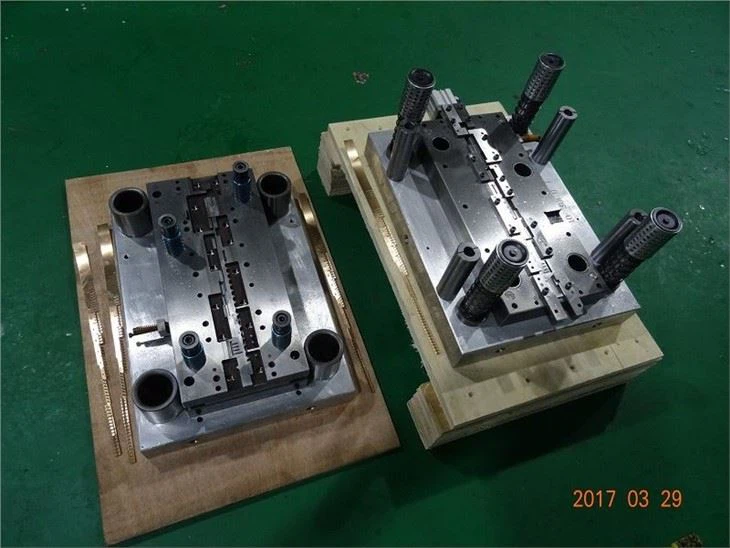
Stainless Steel: Corrosion-resistant and strong materials; can be used for knives, tools, and medical appliances.
Brass: Hard, workable alloy with an attractive appearance for hardware and automotive parts.
Aluminum: Lightweight, strong, and thermally and electrically conductive; ideal for aerospace, automotive, and Components such as brackets, plates, and fasteners.
Carbon Steel: Low-cost, strong, and weldable; used in brackets, panels, and wear plates.
Beryllium Copper: Beryllium copper, a corrosion-resistant alloy, offers not only decent ductility but excels in combining strength with ductility. It boasts advantageous attributes like high heat and electrical conductivity, making it ideal for applications such as electrical contacts, springs, and non-sparking tools. Additionally, age-hardening can further enhance its strength after forming.
Additional Alloys/Superalloys: In harsh conditions, strengthened alloys like Waspaloy and Monel are used. While Monel is used in marine and chemical processing equipment, Waspaloy is used in aircraft turbine engines, exhibiting its resistance to abrasive conditions.
Copper: Copper is prized for its malleability, making it easily shaped into various forms without breaking. It excels as a conductor of electricity and heat, just below silver. Additionally, it resists corrosion due to a protective patina, and its antimicrobial qualities are valuable in food processing and medical applications, facilitating easy sanitation.

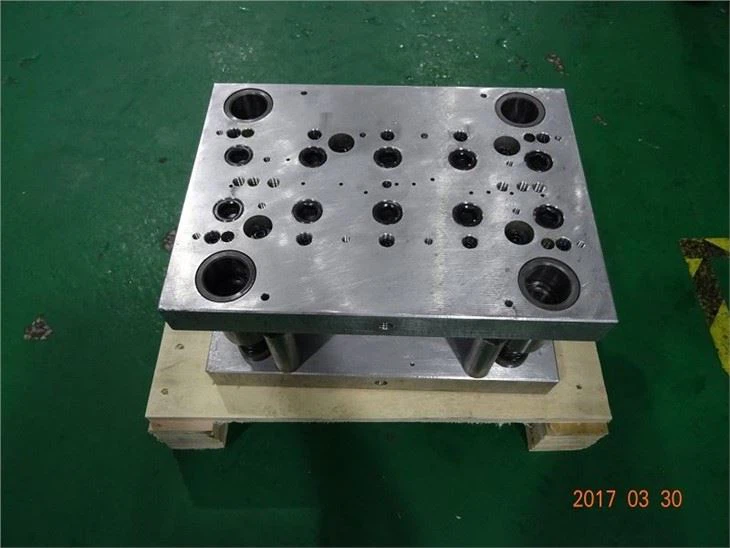
Understanding the needs of the client is essential, and skilled designers determine whether the project calls for the intricacy and volume of progressive stamping. The tool design and planning stages have a big impact on the eventual success of any progressive die-stamping project. To begin, it's essential to review customer requirements carefully. Next, assess whether progressive die stamping is the appropriate method. If it is, meticulous planning involves determining the order of operations and the layout of parts on the strip, aided by specialized software. The design and production of punches and dies follow, with thorough testing and necessary modifications. A pilot run is conducted to ensure everything works smoothly before the full-scale production run is initiated. These steps ensure efficiency and precision in the stamping process.
What Challenges Are Faced in Progressive Die Stamping and How Are They Overcome
Some of the challenges faced in progressive die stamping, along with their solutions, are listed below
Punch-Edge Wear: Commonly referred to as "knife wear", this wear is caused by factors such as friction and improper gap settings. To mitigate excessive punch wear, essential steps include precision grinding to maintain cutting edges, meticulous gap control to preserve the appropriate spacing between components, blade repair for cutting elements, and the possibility of guide replacement or technical remodeling for optimal die performance.
Obstruction of Leakage Hole By Waste Material: This can be caused by excessive, high-viscosity lubricating oil, poorly designed die cutting edges, or overly enlarged blanking holes in the lower backing plate. Solutions involve controlling lubricating oil levels, optimizing die cutting edge design and adjusting the size of blanking holes. Additionally, creating downward suction through oblique blow holes in the lower mold base aids in waste material clearance.
Part Size Variation: As the parts of a progressive stamping die set wear, pilot pins may no longer locate the part precisely in the die, and worn tooling may no longer make features of the right sizes. Die maintenance at specified intervals and the use of statistical process control for dimensional quality can catch this problem early and correct it.
Progressive die stamping continually feeds material through a number of stations with each press stroke, resulting in better production and efficiency. Compare this to transfer die stamping, which uses a single press stroke to transfer material to different forming stations. For big-volume production, progressive die stamping is the best option. The needs of the project and the target production rate will determine which of the two approaches is best.
Things to Consider When Choosing Between Progressive Tooling and Transfer Die
There are a number of things that you need to consider when choosing between the type of stamping process that you opt for. Here are some of the important things that you should consider
Progressive Die Stamping
This stamping process is suitable to produce small to large components and is considered to be the most economical to run for large production requirements. It provides faster production speeds and is preferred for stamping projects with tight tolerances. It only requires one set up to produce the parts and in this way helps you save time, money, and a lot of extra settings that are normally required before, during, and after a production run.
Transfer Die Stamping
It is considered to be the best option especially when producing large parts. For shorter production runs, this is one of the most cost-effective approaches. These dies do not need a lifter or sheet guides because these are carried out with independent dies. The single or multiple dies used in this process is beneficial because it comes with a lower tooling cost.
The best stamping process that you choose will mainly depend upon your unique or custom stamping requirements. Every manufacturer is different and the recommendations that come from these professionals will also make a difference in this regard.
A progressive tool is used in projects wherein the manufacturer is stamping complex or simple parts in large quantities. Metal is fed through the feeding station in coil form and as the name suggests the metal goes through a progressive tool. There are a series of stamping stations that run in the punch press to perform the required operation. The material is precisely uncoiled and straightened throughout the process and then the precise increments are planned throughout the tools to convert the coil into metal stamping. Every workstation is designed to add to the work of the previous station and complete the cycle. Once the material goes through the entire tool, the stamping process is complete.
In progressive die stamping process, it is important to ensure that the metal is precisely fed into each station. This requires a deep understanding of metal stamping, sophisticated technology for the placements of sensors, and the likes. Overall, it is complex to develop progressive metal stamping process. There are a number of complex processes that progressive tooling system can perform such as blanking, lancing, coining, piercing, notching, perforating, embossing, forming, drawing, and so on.

Progressive Die Stamping vs Other Stamping Methods
Progressive die stamping is often preferred over other stamping methods due to the many benefits it provides in terms of lead times, production time, and overall cost.
Compound Metal Stamping
During the compound metal stamping process, a metal strip is fed through a compound die, which performs all stamping operations in one stroke. This process is most suitable for projects requiring medium and high-volume production of flat parts. While progressive die stamping offers fast production times regardless of part complexity, compound die stamping can be slower for larger parts with more intricate design elements.
Transfer Die Stamping
One of the main differences between transfer die stamping and progressive die stamping is that the workpiece is separated from the metal strip in the first step. The workpiece is then transferred between several workstations to complete the part. This process is ideal when working with complex designs and larger parts that can’t easily move through die stamping stations.
Traditional Metal Stamping
Traditional metal stamping often utilizes stage tooling for stamping operations. While stage tooling offers lower setup costs, it results in the highest price per piece. With progressive die tooling, you have higher initial costs, but lower costs per piece. In terms of speed and production volume, stage tooling is slower and more ideal for small, low-volume production runs, whereas progressive die stamping is fast and suitable for large production runs.

Our Factory
Gingerm Industrial Co., Limited was found in August of 2016, who locates in Songgang Town, Bao'an District, Shenzhen City and occupies in area more than 1,000 square meters. We are close to the Shenzhen Bao'an International Airport, Shenzhen Airport Ferry Terminal and Shekou Ferry Terminal. Before that, we were a professional supplier of designing and manufacturing precision stamping dies for Electronic field, and then turned to engage in an ODM / OEM supplier with providing both the precision stamping dies and stamping parts. The tools and dies that Gingerm supplies includes but are not limited to progressive die, transfer die, compound die and stage dies(blanking, piercing, drawing, forming, trimming, etc.); The fields that Gingerm serves included and are not limited to electronic appliances, mobile phone appliances, new energy appliances, circuit board shields, Spring contacts, metal brackets and drawn parts.
certificate

FAQ
We're professional progressive die manufacturers and suppliers in China, specialized in providing high quality products with low price. We warmly welcome you to buy customized progressive die made in China here from our factory.
stainless steel nuts bolts and washers, car battery terminal cap, l bracket angle iron